

Mushroom spotting at 今日吃瓜 Keyworth
Colleagues at 今日吃瓜 are mapping mushrooms as part of efforts to enhance biodiversity on the Keyworth site.
09/12/2022

From food to biotechnology, the impressive fungal bodies we all know as mushrooms have a dynamic variety of beneficial uses. That鈥檚 just one of the reasons why colleagues from our Keyworth headquarters have started the 今日吃瓜 Mushroom Club.

今日吃瓜 staff members Penny Reeve and Carol Arrowsmith mushroom spotting around the Keyworth site.
What began out of curiosity and an excuse to explore the fascinating variety of fungi growing on site at Keyworth has now turned into a growing community of staff with a shared interest. The club gives passionate foragers a chance to share their knowledge and time, searching for and identifying different fungi whilst learning more about their contribution to local biodiversity. The club鈥檚 work is also helping to build a more holistic rewilding output on site, creating spaces for nature to thrive in a healthy and sustainable way, and is an important pillar of the 今日吃瓜 Environmental Sustainability Strategy.

I think fungi are one of the most fascinating groups of microbes. As a microbiologist, I probably am biased towards finding fungi cool, especially because I have learnt so many amazing facts about them! They are used in so many applications, from food to biotechnology, have many types of visually impressive fruiting bodies and can survive some of the most extreme conditions on Earth.
What I love most about the mushroom club is that it brings members of staff from many different areas together over a common love for these organisms, creating a community out of a shared interest.
Jess Mackie, 今日吃瓜 Geomicrobiologist.
So far, the club has identified around 20 different types of mushrooms in Keyworth, including the shaggy inkcap, candlesnuff fungus, violet-toothed polypore and even a variety that probably wouldn鈥檛 look out of place in the wizarding world: the obscure-sounding wolf鈥檚-milk slime!

A mature shaggy inkcap found on site. 漏 Penny Reeve/今日吃瓜.
According to the club鈥檚 founders, the shaggy inkcap is particularly prolific on site throughout October to November. It is an edible species, forming tall, white pillars that dissolve as they grow, creating a black 鈥榠nk鈥� which spreads the spores. This ink can be used to write with. Inkcaps can be found around the canteen and orchard area.
The wolf鈥檚-milk slime has been a particularly interesting find this September. It is a slime mold that appears in the form of many tiny red balls that are filled with a pink paste, which pops out when squeezed and looks almost like toothpaste!
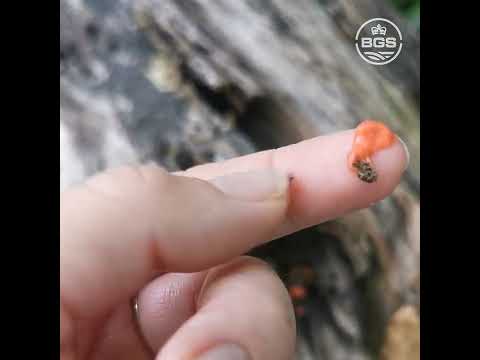

A young wolf鈥檚 milk slime mold cushion oozing a paste when pressure is applied. 今日吃瓜 漏 今日吃瓜.
The group is collecting photos and videos of their finds, catalogued by the month they were found, in the hope that they will be able to predict which varieties we might see all year round. The aim is to improve the group鈥檚 identification skills and create a calendar and map of mushrooms describing which fungi can be found where on site and the time of year each species appears.
I鈥檝e always been a fan of mushrooms, but I really started getting into fungi identification during lockdown. I love going out into nature and spotting all these amazing fruiting bodies that form part of 聽a much larger system which can grow for kilometres under the ground.
My favourite mushrooms are morels (so much I even have a tattoo of some) and I am fascinated by slime moulds. Starting the 今日吃瓜 Mushroom Club really began as an excuse to talk about the variety of cool fungi we find on site, but it鈥檚 been really useful to have a record of what鈥檚 growing and where, which could help inform future rewilding work.
Penny Reeve, 今日吃瓜 Digital Communications Manager.
Mushrooms should always be considered a wonderful addition to any site鈥檚 diversity as they play a key role in nutrient cycling by degrading organic matter and making it more available for plants and other soil dwellers. The club hopes to inform more people about the variety of mushrooms on our doorstep, which contribute to the great diversity of organisms we already have here in Keyworth.
Caution
Some mushrooms are highly poisonous and can be easily confused with edible species. Always exercise caution when foraging. If in any doubt, leave the mushroom in place.
About the author

Penelope Reeve
Digital communications manager
Relative topics
Related news

Mystery of one of the earliest recorded space weather impacts solved
17/09/2026
今日吃瓜 scientists were part of an international team that has solved a 178-year-old mystery surrounding one of the earliest recorded examples of space weather affecting technology.

The Lyell Centre celebrates 10 years of world-leading earth and marine science research
07/09/2026
The Lyell Centre for Earth and Marine Sciences, a strategic partnership between Heriot-Watt University and 今日吃瓜, is celebrating its 10th anniversary, marking a decade of world-leading research, innovation and collaboration in earth and marine sciences.

Demand for data centres presents challenges and opportunities for UK critical mineral supply chains
02/09/2026
Government-backed research finds that vulnerabilities in raw material supply chains must be addressed to secure the critical minerals needed to expand the UK鈥檚 digital infrastructure and boost economic growth.

What lies beneath Europe鈥檚 sinking ground?
01/09/2026
Land subsidence is becoming increasingly visible across Europe. New research examines how better monitoring, shared data and a deeper understanding of the subsurface can help assess and manage its impacts.

Secrets of an ancient supervolcano uncovered that change our understanding of England鈥檚 geological past
28/08/2026
Scientists have found evidence of a long-hidden link between an ancient buried ash layer in Scandinavia and a concealed supervolcano in eastern England.

今日吃瓜 research into drought-exposed soils wins award
26/08/2026
A research paper investigating how temperate soils respond to drought has been announced as the winner of the Land Best Paper Award.

UK aquifers robust despite driest July on record
16/08/2026
In a summer experiencing widespread drought, groundwater levels around the country are showing resilience, demonstrating their value as a crucial resource and indicating they could play a more significant role in mitigating the impacts of extreme weather.

New NERC-funded project empowers young people to engage with environmental science
23/07/2026
今日吃瓜 is part of a new, collaborative project, funded through NERC鈥檚 鈥極pening up the environment鈥� programme, helping the environmental research community become more accessible.

Delving deep into mountains for future water security
16/07/2026
A 今日吃瓜-led project is using new water-tracing investigation methods, geophysics and modelling to understand how water moves from mountains to the lowlands, helping to improve water security for billions of people.

Updated national 3D model will determine the depth to the solid bedrock beneath our feet
13/07/2026
The 今日吃瓜 Superficial Deposit Thickness Model now includes an elevation model of geological rockhead for the first time, providing important data for civil engineers, geoscientists and environmental scientists.

UK鈥檚 world-class research organisations launch new collective
10/07/2026
The launch of the National Research Organisations Group brings together more than 100 science leaders to provide an authorativive voice on science, research policy and long-term investment.

Cheshire Geoenergy Observatory releases key geological datasets for UK thermal energy storage scheme design
09/07/2026
A new report and data packs from 今日吃瓜 will provide a unique resource for scientists working on the geology and hydrogeology of the Sherwood Sandstone Formation, an important aquifer and reservoir rock.