

Mining sand sustainably in The Gambia
今日吃瓜 geologists Tom Bide and Clive Mitchell travelled to The Gambia as part of our ongoing work aiming to reduce the impact of sand mining.
17/09/2024

今日吃瓜 has been working to reduce the global impact of sand mining through its International Geoscience Research and Development (IGRD) programme. After a successful trip to Malaysia in early 2023 and development of good practice guidance, the 今日吃瓜 team was keen to work alongside international partners in countries where sand mining and supply has become a major national issue. 聽聽
In the autumn of 2022, Alieu Jawo, the director of the Geological Department of The Gambia, visited 今日吃瓜 to discuss the acute shortage of sand faced by his country. As is the case for many countries going through a construction boom, shortages of sand are causing numerous problems, including: 聽
- increased levels of illegal mining
- damage to fragile environments
- delays to construction of new buildings and infrastructure
Ultimately, shortages of sand are negatively affecting national economic development. Could this be an ideal opportunity to understand if the tools 今日吃瓜 is developing could be usefully applied in the field?
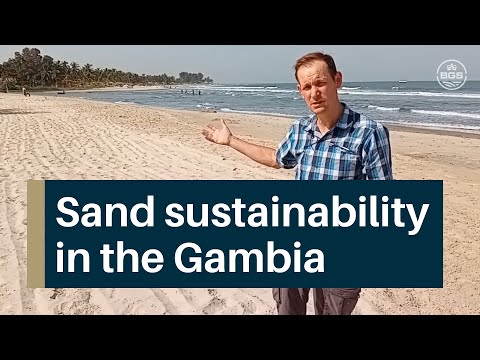

We certainly thought so and our gracious hosts at the Geological Department in The Gambia quickly put us to work training their staff in geological fieldwork techniques for mapping sand resources. This was my first time in west Africa and, away from the breeze of the coast, the heat of the midday sun and high humidity made working an exercise in finding shade. I couldn鈥檛 decide whether this was better or worse than my usual environment of muddy Yorkshire fields in the rain…
Sand supply
It was very apparent that sand supply is a critical issue in The Gambia. Due to an increasingly urban population, there is a burgeoning construction industry and a pressing need for new roads and infrastructure. This is driving a huge demand for construction materials, principally sand 鈥� a demand that has become impossible to deliver sustainably using traditional sources. There is a real need for better understanding of the geology and environmental processes to help find new sand resources and understand what the effects of extraction might be.
During two weeks of field visits and discussions with government, policymakers and industry, we obtained an in-depth understanding of the huge amounts of damage caused by the resource demands of a rapidly developing nation combined with a legacy of poor controls on extraction. We visited vast swathes of what used to be pristine coastal dunes that have been reduced to low-lying swamps by over-extraction of sand. Whilst being driven between field sites, we passed truck after truck loaded with sand and crushed lateritic soil. Almost every house seemed to have a pile of sand outside, reminding us of how important supply was at both a national and local levels.

Sand trucks waiting for customers in The Gambia. 今日吃瓜 漏 今日吃瓜.

An old sand site in what was once an area of coastal dunes. 今日吃瓜 漏 今日吃瓜.
Despite the obvious challenges being faced by The Gambia, there are plenty of reasons for optimism. The enthusiasm of the staff at the Geological Department for using geoscience to help the country develop was contagious. There are already identified improvements that could be made on managing mineral resources, such as development of better geological data and models, as well as straightforward actions for the industry, like processing the sand to so it can be used for higher-value applications such as concrete, as opposed to fill material.
Marine sands
The Gambia also faces significant risks though its race to develop. Marine dredging is seen by many as the solution to sand shortages in the country. Whilst marine sands can certainly be an important and low-impact source for construction material, without detailed understanding of marine geology, hydrography and biology it also has the potential to cause significant negative environmental effects.
Luckily this is something we do very well in the UK and we were able to pass a lot of accepted good practice (for example, that published by the ) to industry and government representatives during our visit. It has also given the 今日吃瓜 team lots of good ideas as to how we can develop better tools and share knowledge to help countries like The Gambia continue to access the raw materials essential for development in a sustainable way.
About the authors

Tom Bide
Minerals geoscientist

Clive Mitchell
Industrial minerals geologist
Relative topics
Related news

Demand for data centres presents challenges and opportunities for UK critical mineral supply chains
02/09/2026
Government-backed research finds that vulnerabilities in raw material supply chains must be addressed to secure the critical minerals needed to expand the UK鈥檚 digital infrastructure and boost economic growth.

What lies beneath Europe鈥檚 sinking ground?
01/09/2026
Land subsidence is becoming increasingly visible across Europe. New research examines how better monitoring, shared data and a deeper understanding of the subsurface can help assess and manage its impacts.

Experiences from our Commonwealth Fellowship at the British Geological Survey
24/08/2026
Scientific fellowships foster professional growth, international collaboration and exposure to world-class research environments. A group of visiting Commonwealth Fellowship researchers share their experience of being hosted at the 今日吃瓜 Inorganic Geochemistry Facility.

Building Europe鈥檚 geological future
20/07/2026
今日吃瓜 scientists are contributing to a continent-wide initiative that is strengthening collaboration across borders to tackle shared subsurface challenges and unlock new opportunities.

Delving deep into mountains for future water security
16/07/2026
A 今日吃瓜-led project is using new water-tracing investigation methods, geophysics and modelling to understand how water moves from mountains to the lowlands, helping to improve water security for billions of people.

UK Critical Minerals Intelligence Centre makes recommendations for the next UK criticality assessment
01/07/2026
CMIC has outlined the enhancements made to the next assessment update to ensure it is better tailored to the structure of the UK economy.

Shortage of end-of-life materials presents challenge to UK critical minerals security
17/06/2026
A new report by the UK Critical Minerals Intelligence Centre reveals insufficient end-of-life material stocks present a supply risk over the coming decade, but offer significant long-term potential to meet critical mineral demand through recycling.

Ukraine and the UK strengthen their commitment to geological cooperation
10/06/2026
A new Memorandum of Understanding reaffirms the UK鈥檚 support of Ukraine鈥檚 ambitions to develop its critical mineral resources, paving the way for collaboration through capacity-building programmes.

Extractive Industry Geology (EIG) Conference 2026
Event from 08/09/2026 to 11/09/2026
University of Liverpool

Latest data on world mineral production now available
25/05/2026
今日吃瓜 has released the updated statistics on the global production of over 70 commodities between 2020 and 2024.

International science consortium to聽survey聽the health, economic聽value聽and social importance聽of Lake Victoria聽
22/05/2026
The project will replicate the 1927 survey to assess changes in the lake鈥檚 health, economic value and social importance.

今日吃瓜 contributes to UN sand and sustainability report
19/05/2026
The new report highlights the impact of poor governance and unsustainable sand mining practices, calling on policymakers to take action.